



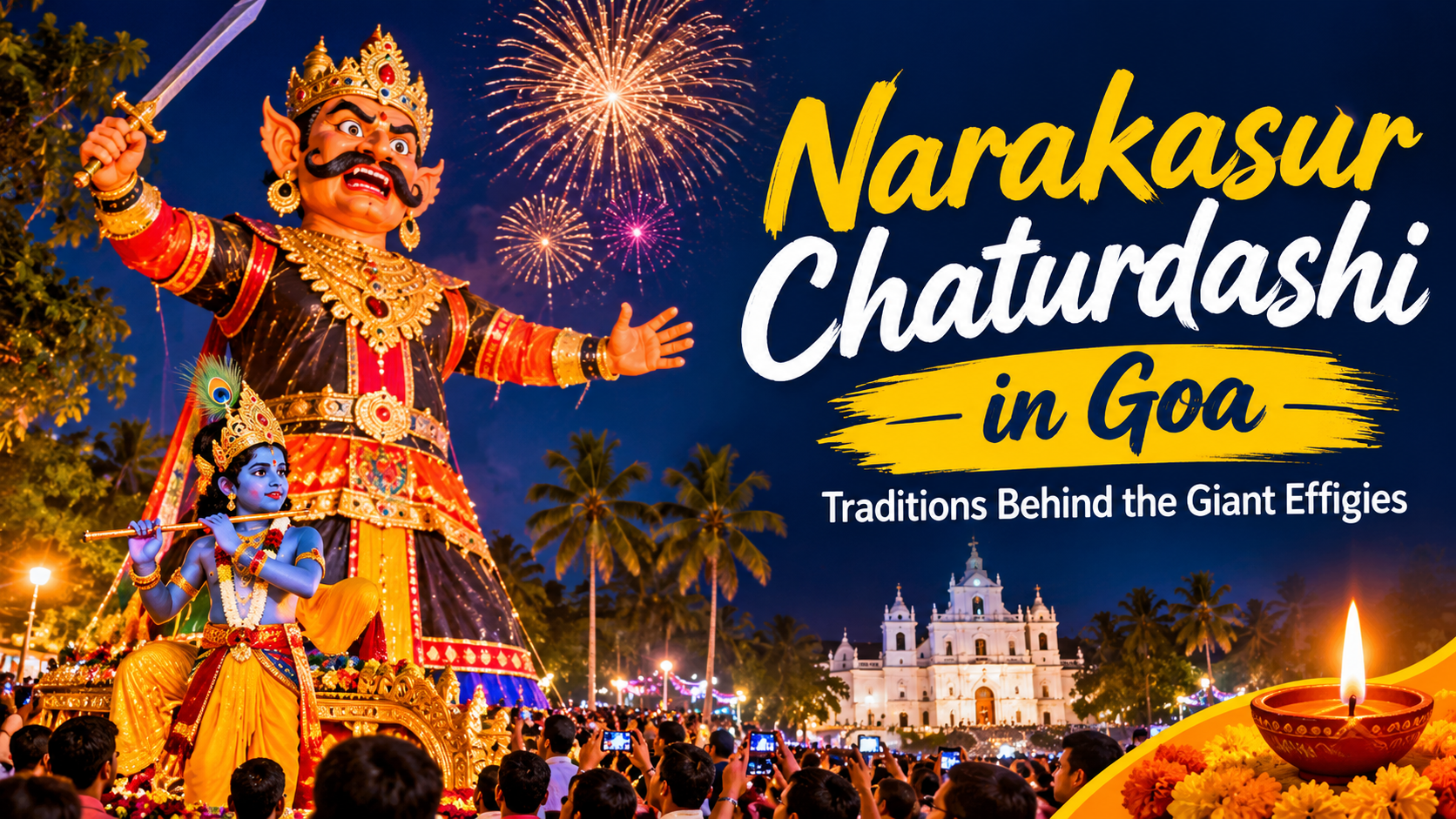
Somewhere past midnight, a street in Panaji fills with drums, flashing lights, and a two-storey demon rolling past on a truck. Children watch from their parents’ shoulders. A boy dressed as Krishna waits on a chariot nearby. This is the Narakasur festival in Goa, one of the most distinctive ways the state marks the eve of Diwali, and it looks nothing like the quiet lamp-lighting many visitors expect from a festival of lights.
The tradition blends mythology, neighborhood craft, and friendly rivalry between villages. This guide covers the story behind it, how the effigies are built, how the competitions work, and how to plan a night out for the 2026 celebrations.
What Narakasur Chaturdashi Means in Goa
Narak Chaturdashi falls on the fourteenth lunar day of the dark fortnight, the day before the main Diwali celebrations. Across much of India, it goes by the name Choti Diwali, a gentler prelude to Lakshmi Puja. Anyone searching for Choti Diwali Goa will find that the state keeps its own version. Instead of a quiet evening at home, Goa turns the night into a public celebration around the demon the locals call Narkasur.
The Story Behind the Demon
Any look at Narakasur history in Goa starts with the myth itself. According to Hindu mythology, Narakasura was a powerful ruler who grew arrogant and tyrannical, bringing suffering to both humans and the devas. Krishna, accompanied by Satyabhama, confronted and defeated him. The victory came to stand for good over evil and light over darkness, which is why the story sits right before Diwali.
Goa gives the legend a physical form. Written records on exactly when Goan communities began building and burning effigies are hard to find, so the origin of the custom is best described cautiously. What local accounts do show is a practice rooted in community memory, with young people in many villages and neighborhoods growing up helping to build the demon each year.
How the Giant Effigies Are Made
Builders use bamboo, paper, cloth, and hay, and papier-mâché finishes many of the figures. Neighborhood youth groups often race to finish in time, since the effigy stays on display for only a few hours before it burns.
Competition effigies take this much further. Some stand close to two storeys tall and move through crowded streets with music, lights, and sound effects. Many use hydraulic systems to move the head, arms, or jaw. Cost varies widely, and a few builders have said that elaborate figures can run to ₹2 or ₹3 lakh, with the hydraulics making up a large share. Smaller groups keep to simpler frames and hand-operated parts.
Competitions and the Role of Krishna
The competitions are where the Narkasur festival takes on a theatrical edge. Known as Narakasur Vadh contests, they run in towns such as Panaji, Margao, and Vasco through the night and into the early morning. Teams bring effigies from different villages, often by truck. Each effigy travels with a chariot carrying a boy dressed as Krishna, and when the performance reaches its peak, Krishna strikes and the demon’s neck breaks.
Judges look at more than size. Past results have included separate prizes for the best Krishna, best music, and most unusual effigy. Organizers in recent years have also encouraged traditional instruments like the dhol and the observance of sound limits.
A few details show how established these events are:
- The Deulwada Yuvak Mandal competition in Panaji held its 37th edition in 2024 at the Mahalaxmi Temple.
- The Solid Party Trust competition in Margao held its 28th edition the same year, with six groups taking part.
- A Vasco competition in 2025 offered a first prize of ₹1,00,000 and ran a separate contest for children under 15, with effigies between 4 and 8 feet tall.
Narkasur in Goa 2026: Dates and Timing
Plans for Narkasur in Goa 2026 should be built around two days, since the celebration crosses midnight. The key dates, using Goa Tourism’s published schedule and panchang timings:
| Event | When |
| Chaturdashi tithi begins | Saturday, 7 November, about 10:48 AM IST |
| Narkasur night begins | Evening of 7 November, with many visitors heading out from around 8:00 PM |
| Celebrations build | Closer to midnight |
| Effigy burning | Pre-dawn hours of Sunday, 8 November |
| Chaturdashi tithi ends | Sunday, 8 November, about 11:28 AM IST |
| Lakshmi Puja (Diwali) | Evening of 8 November |
Exact procession and competition timings differ by locality, and panchang times can vary slightly between sources. Checking locally closer to the date is a sensible step.
What Happens After the Burning
The effigy goes up in flames before dawn, and the day begins with ritual. Families take an early Abhyanga Snan, a ceremonial oil bath, then light diyas, share sweets, and prepare for Diwali. Lakshmi Puja follows in the evening.
Looking for a pure veg resort in North Goa during Narakasur Chaturdashi holiday? Explore vegetarian dining at Aur Jalsa, Resort Rio.
Where to Watch
Effigies appear across the state, though some areas have a reputation for lively displays. Goa Tourism points to several:
- Panaji, Taleigao, Mala, and Bhatlem: elaborate effigies, music, and crowds moving between displays, with the area around St. Inez also worth exploring
- Margao: several neighborhoods take part, which makes it possible to see multiple creations in one evening
- Mapusa and Bardez villages: neighborhood celebrations rather than one large spectacle
- Ponda: community-driven celebrations in different neighborhoods
- Vasco da Gama and Mormugao: locally made effigies, music, and late-night festivities
Some of the most memorable experiences happen away from organized events. Anyone curious about Narkasur in Goa can also drive through villages and see effigies displayed in squares and along local roads.
Tips for Visitors
Crowds, road closures, and religious sensitivities all shape the night. Anyone planning to see the Narkasur festival in person can keep these points in mind:
- Respect local customs and community spaces
- Expect crowds and temporary traffic restrictions near major venues
- Arrive early to catch processions
- Follow instructions from organizers and local authorities
- Photograph respectfully, especially around religious rituals
Police have issued guidelines to participating teams in places like Panaji, Agassaim, and Old Goa in past years, so rules can differ by location.
Celebrating Narakasur Chaturdashi with family or friends? Explore a spacious Goa resort villa at Resort Rio for a relaxing festive holiday.
How the Tradition Is Changing
A full picture of Narakasur history in Goa also has to include recent changes. One Goan columnist writing in 2025 observed that effigies have grown larger and more impersonal, with sponsors and organizations backing many competing groups, and that the old days of neighbors recognizing who danced inside the costume are fading. Others point to smaller village celebrations as the place where the older spirit survives. Both views appear in local conversation, which says something about how much the festival matters.
Common Mistakes When Planning a Narkasur Night
A few planning errors can leave visitors disappointed:
- Assuming one central event instead of many neighborhood and competition venues
- Arriving after midnight and missing the processions
- Driving into crowded areas without checking road arrangements
- Treating the burning as a daytime event, when it takes place before dawn
- Skipping local announcements for exact timings
Conclusion
The giant effigies, the nighttime processions, and the pre-dawn burning give Goa’s Diwali eve a character found almost nowhere else. For anyone planning Narakasur in Goa 2026, the best approach is to stay flexible, head out in the evening of 7 November, and let the night unfold from one neighborhood to the next.
At Resort Rio, we would love to host you in Goa for the Narakasur festival in Goa and the Diwali celebrations that follow.
ren under 15 with smaller effigies.
