



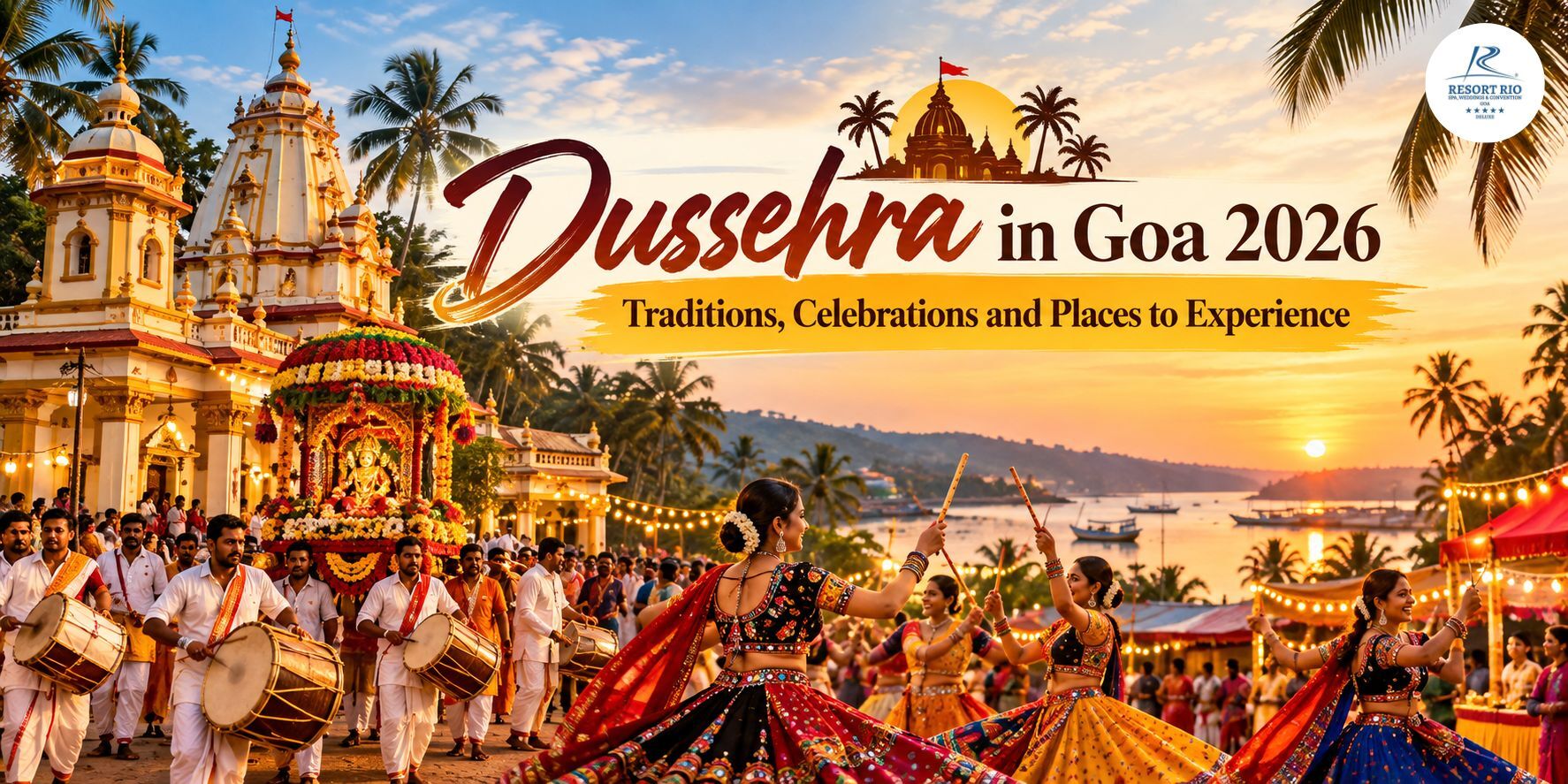
Goa has a distinct way of marking Navratri and Vijayadashami. In 2026, Vijayadashami falls on Tuesday, 20 October. Sharadiya Navratri starts on 11 October and leads into the tenth-day festival. The temples around Ponda are especially important during this period. They hold prayers and local rituals. Makharotsav is also linked with several temples in this area and at the same time, cities across Goa host Garba and Dandiya events.
Goa also continues to attract large numbers of visitors. The state recorded 61.38 lakh tourist arrivals between January and July 2026. This included 59.02 lakh domestic visitors and 2.36 lakh international visitors, based on Department of Tourism data reported in August 2026.
In this article, we will talk about Dussehra in Goa 2026, its traditions and history, the main Dussehra events, and what you can expect during the festive period.
When Is Dussehra In Goa 2026?
The main dussehra festival date in Goa is 20 October 2026. It falls on a Tuesday. Navratri begins on 11 October. Vijayadashami comes on the tenth day. This is why the dussehra start date can cause some confusion. Navratri is the nine-night period. Dussehra refers to Vijayadashami, the tenth day.
Add comfort to your festive holiday by exploring the best 5 star resorts in Goa for your stay.
For Panaji, the Dashami tithi starts at 12:50 pm on 20 October and ends at 2:11 pm on 21 October. The Vijay Muhurat is listed as 2:17 pm to 3:04 pm for Panaji. But, temple timings can differ, so check with the temple before planning a puja.
The 2026 calendar is:
| Festival day | Date |
| Navratri begins | 11 October 2026 |
| Durga Ashtami | 19 October 2026 |
| Maha Navami | 19 October 2026 |
| Vijayadashami / Dussehra | 20 October 2026 |
The dates above are based on the 2026 Hindu calendar for Goa.
Related read: Upcoming Festivals in Goa: A Complete Guide to September – December Celebrations
Dussehra History And Its Meaning
The dussehra history goes back to several Hindu traditions. One tradition links Vijayadashami with Lord Rama’s victory over Ravana. Another links the day with Goddess Durga’s victory over Mahishasura. But, both traditions focus on the victory of good over harmful forces.
The dussehra history in Goa also has a strong connection with the state’s temples. Several Hindu deities were moved from their older temple sites during Portuguese rule. New temples were later built in areas such as Ponda. This helped Ponda become an important centre for Hindu worship in Goa.
Shantadurga Temple at Kavlem is one example. Goa Tourism says the original temple was at Quelossim and that the deity was moved to Kavlem. Also, the present temple was built between 1730 and 1738. Mahalasa Narayani Temple at Mardol is another key temple nearby. Its history is also linked with the movement of the deity from an older site.
This history helps explain why the local dussehra festival may look different from celebrations in North India. You may not see large Ravana effigies at every temple. Instead, the focus can be on the deity, temple rituals, music and processions.
Make your festive dining experience more enjoyable by exploring buffet restaurants in Goa during your Dussehra holiday.
Makharotsav During Navratri
Makharotsav is one of the local traditions to watch during the festive period. A makhar is a decorated swing or ceremonial structure. A representation of the deity is placed on it. Devotees then take part in the ritual while musicians perform.
Reports from Ponda have described instruments such as dhol, and shehnai during Makharotsav. The Mahalasa Narayani Temple at Mardol is among the temples associated with this tradition.
The ritual shows why a Goa festival during Navratri cannot be reduced to Garba and Dandiya. Temple customs have their own place in the calendar. You may also find kirtans and other devotional programmes before the main evening activities. But, the exact schedule can change each year. So, check with the temple before visiting.
Planning a family holiday around the festivities? Discover a Goa resort villa for a comfortable stay with your loved ones.
Seemollanghan and Dussehra Customs
Seemollanghan is another important ritual linked with Vijayadashami. The word refers to crossing a boundary. In some traditions, the deity is taken beyond the temple or village boundary.
The ritual has a symbolic meaning. It marks the crossing of a known limit on an auspicious day. Some communities also exchange Apta leaves. These leaves can represent gold in the traditional custom. People may take them home as a sign of good fortune.
Taranga processions are also seen in some Goan temple traditions. A taranga can represent the presence of a deity during a procession. These customs are not the same at every temple. Your dussehra celebration may therefore differ from one village to another.
That local difference is important. There is no single programme followed across the whole state.
Also read: Is October a Good Time to Visit Goa? Weather, Beaches, Crowds and Things to Do
Best places for Dussehra in Goa
Ponda is a good area to include in your plans because several major temples are close to each other.
1. Shantadurga Temple, Kavlem
Shantadurga Temple is in Kavlem in Ponda taluka. The present temple was completed in 1738. Goa Tourism says the temple is dedicated to Shantadurga. She is associated with bringing peace between Vishnu and Shiva in the temple’s traditional account.
The temple is also an important part of Goa’s wider Hindu temple circuit.
2. Mahalasa Narayani Temple, Mardol
Mahalasa Narayani Temple is close to the Mangeshi area. It is associated with Makharotsav during Navratri. The temple’s history also reflects the movement of Goan deities from older sites during Portuguese rule.
For people interested in traditional temple customs, this is one of the places worth checking during the festival period.
3. Mangeshi Temple
Mangeshi is one of Goa’s best-known Hindu temples. It is located in Priol in Ponda taluka. The temple is dedicated to Lord Shiva and forms part of the important temple belt in the area.
Check the temple’s festival notices before planning a visit. The daily worship schedule and festival activities may differ.
4. Mahalakshmi Temple, Bandora
Mahalakshmi Temple is another important shrine near Ponda. It gives you another option when visiting the temple belt. You can also combine several nearby temples in one day instead of travelling across the state.
5. Kamakshi Saunsthan, Shiroda
The Kamakshi temple is in Shiroda. A Goa government tourism resource says over 25,000 devotees gather at the temple for Dussehra. It also has several associated shrines and traditional palanquin processions. This makes it a relevant place to check for the 2026 dussehra celebration schedule.
6. Bhagwati Temple, Pernem
Bhagwati Temple in Pernem has a particularly large Dussehra gathering. A Goa government tourism resource says that more than 25,000 devotees assemble at the temple for Dussehra.
Expect a large crowd if you visit around the main festival day.
Also read: Why September to November Is Becoming a New Travel Window
Garba and Dandiya in Goa
The modern side of the dussehra festival is easy to find in Goa’s towns and cities. During Navratri, organisers hold Garba and Dandiya nights at different venues. These events often include music, and traditional clothing.
Garba and Dandiya are different forms of dance. Garba uses circular movements. Dandiya Raas uses decorated sticks. Many public events include both.
These events are part of the wider Goa festival calendar during October. They are different from temple rituals, so you should choose the setting that matches what you want to see.
Event dates and venues can change from year to year. Check the organiser’s latest announcement before travelling to a specific venue.
Exploring Goa during Navratri? Find veg restaurants in Goa to enjoy vegetarian meals throughout your festive trip.
How Dussehra is Celebrated in Goa
A typical dussehra celebration can include several parts:
- Temple prayers
- Special decorations
- Kirtans and devotional music
- Makharotsav
- Palanquin processions
- Seemollanghan
- Community gatherings
- Garba and Dandiya events
- Traditional food and local stalls
The exact programme depends on the temple or community. This is one reason the dussehra festival in Goa is better understood as a group of local traditions rather than one statewide event. The religious side remains important at temples. Public events add a social side in towns and cities.
Dussehra 2026: What Should You Plan For?
The main dussehra festival date is 20 October 2026. For temple visits, plan ahead. Major shrines can become crowded. Some roads may also become busy during processions.
Keep these points in mind:
- Check timings first. Temple rituals may follow a local schedule.
- Dress modestly. Some temples have specific dress rules.
- Remove your footwear before entering areas where it is required.
- Ask before taking photos. Some rituals may not allow photography.
- Allow extra travel time. Processions can affect local traffic.
- Carry water. You may spend time outdoors.
- Check public event details. Garba venues can change each year.
- Respect temple customs and follow instructions from temple staff and volunteers.
The dussehra start date for the wider festive period is 11 October, when Sharadiya Navratri begins. But, the main Vijayadashami observance is on 20 October.
Must read: Goa in October: Festivals, Culture, Weather and Things to Do
Dussehra in Goa 2026: Temple Traditions or Public Events?
Your choice depends on what you want to see. For temple traditions, Ponda and nearby areas are the main places to consider. Shantadurga, and Mahalakshmi are part of the area’s major temple circuit.
For a large gathering, Bhagwati Temple in Pernem is another option. For music and dance, check the public Garba and Dandiya calendar closer to October.
You can also combine the two. Visit a temple during the day or early evening, then attend a public event later. Remember that religious rituals and public dance events follow different rules so treat temple visits as religious visits.
Conclusion
Dussehra in Goa 2026 brings together old temple customs and newer public events. Ponda remains important for its temples and local rituals. Makharotsav gives Navratri a strong local character. Seemollanghan adds another traditional element to Vijayadashami. Public Garba and Dandiya events give the festive period a different setting.
The Goa festival calendar around October can therefore offer several types of events. Check temple notices and event updates before you make your plans. For a stay close to Goa’s major attractions, Resort Rio can be considered as one accommodation option.
The dussehra history of Goa is closely tied to its temples, relocated deities and long-running community customs. That history is still visible during the festive period today.
